CineStill 800T
on Fujifilm
The cult film of night photography. Tungsten-balanced for street neon, famous for the red halation glow around every bright light. Here's what makes CineStill 800T feel like CineStill 800T — and the Fujifilm recipe that translates it without the actual film.
Repackaged Kodak Vision3 500T cinema negative, ISO 800, balanced for 3200K tungsten. Released 2012; the look that defined a generation of nighttime street photography on Instagram.
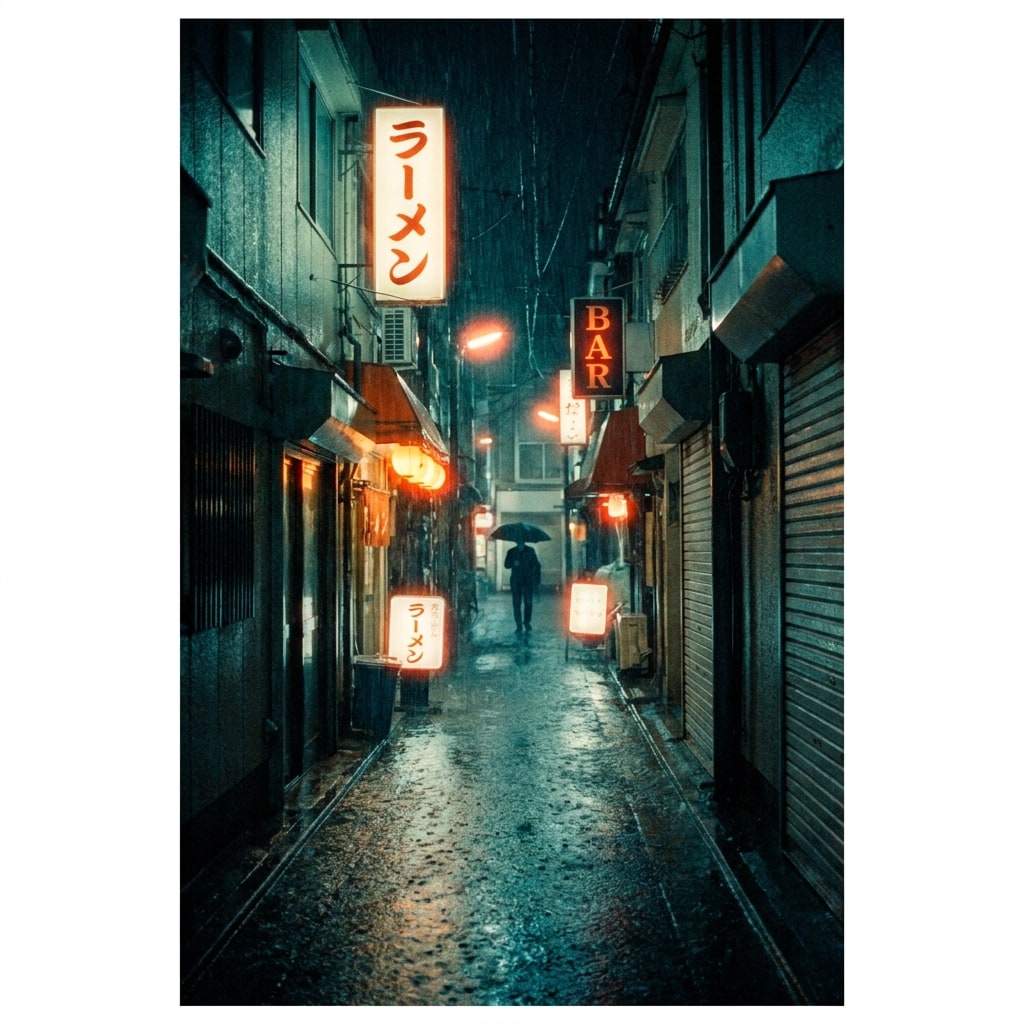
Reference look
What we're translating
A representative scene in the CineStill 800T register — the colour, contrast, and composition the recipes below try to land on a Fujifilm body straight out of camera.
AI-rendered approximation (Gemini 3 Pro Image, prompted to match the CineStill 800T aesthetic). Not a frame from the source material — used for visual orientation only.
What people mean by “CineStill 800T look”
CineStill 800T is a tungsten-balanced film with the cinema negative’s protective remjet layer stripped — and that single removal is where the look comes from. Without remjet, bright light sources scatter through the film base and bounce back through the emulsion, producing the signature red halation glow around every streetlight, sign, and headlight in the frame.
The look that travels under “CineStill 800T” online — the moody, cyan-shadow, red-glowing, slightly-grainy night frame from any Tokyo or NYC street feed — is tungsten white-balance + halation + 800-speed grain. Three moves get you close on a Fuji sensor:
- A film simulation with cool shadows and held-back saturation — Classic Neg is closest (Eterna and Pro Neg Std are runners-up for a more documentary feel).
- Tungsten white-balance setting (~3200K) — this is the most important single move. Without it, neons read as warm-orange instead of CineStill’s signature cyan-shadow / amber-highlight split.
- Slight grain + slight negative noise reduction — the 800-speed CineStill grain is part of the look; Fuji’s STRONG grain is in the right neighbourhood.
The Fuji recipe below translates it for night street work on X-Trans IV and V.
Why halation is the hard part
The actual red glow around lights is a film-physics effect that no in-camera Fuji setting reproduces. The trick people use is either (a) shoot it as a vibe without the halation and accept that the cyan-shadow palette carries most of the look, or (b) add a soft red glow in post (the Dehancer halation pass is the gold standard).
For straight-out-of-camera work, the white-balance is doing 80% of the lifting — that cyan-shadow / amber-highlight split is what the eye reads as “CineStill” even without halation present. Get the WB right; the rest is shotgun composition.
What to look for
A real CineStill 800T translation, not a generic moody night filter:
- Shadows lean cyan, not blue or neutral.
- Tungsten light sources (streetlights, signs) read amber, not white.
- Skin under those lights goes slightly green (this is correct; CineStill does the same).
- Grain is present and uniform, not denoised out.
If shadows are cool but neons are still warm-orange, white-balance wasn’t dropped far enough.
Recipes that deliver it
1 recipe · ready to shoot